

What is a joint replacement?
Joint surfaces are covered with cartilage. When the cartilage thins over time and in places disappears altogether, the bone surfaces rub against one another; movement becomes painful and the joint loses its function.
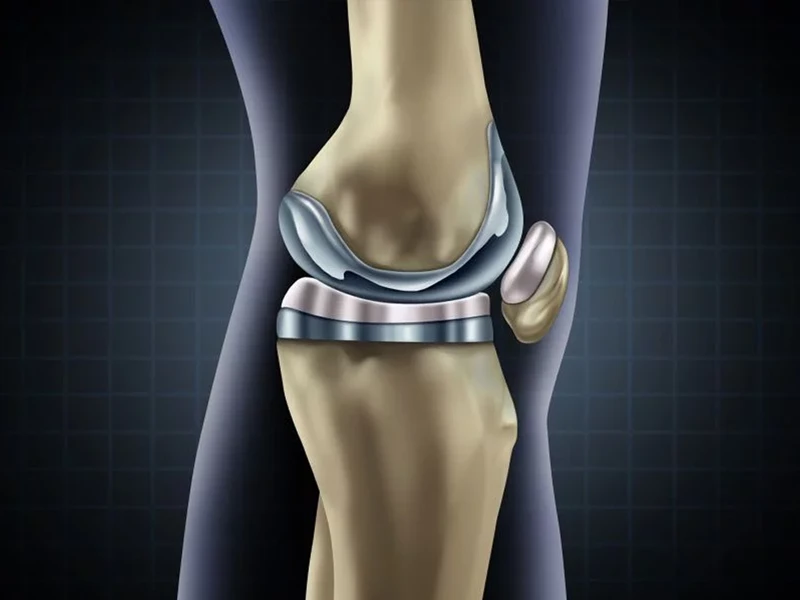
In replacement surgery the worn joint surfaces are removed and artificial surfaces made of metal and special plastic components are put in their place. The aim is to eliminate the rubbing of bone surfaces against one another, thereby reducing pain and restoring movement.
The procedure is most widespread in the knee and hip; it also comes onto the agenda in selected cases in other joints such as the shoulder.
Knee replacement surgery
Knee replacement is the surgical method most often turned to in advanced-stage knee osteoarthritis. The worn joint surfaces are removed and components of a suitable size are put in their place.
The procedure can take two forms:
- Total knee replacement: All the surfaces of the joint are replaced. This is preferred when the wear has spread across the whole knee.
- Partial (unicompartmental) replacement: Only the worn section is replaced. It comes onto the agenda in selected cases where the damage is confined to a single compartment of the knee.
Which method is appropriate is determined by assessing together the extent of the wear, the condition of the ligaments, any deformity in the knee and the person's activity expectations. For knee problems as a whole, see knee surgery.
Hip replacement surgery
The hip joint is a ball-and-socket joint formed by the head of the thigh bone and the socket in the pelvis. Wear in this structure leads to pain in the groin and hip region, a shortened walking distance and difficulty with everyday movements such as putting on shoes.
In a hip replacement both the head of the thigh bone and the surface of the socket are replaced. Hip replacement comes onto the agenda not only in osteoarthritis; it may also follow avascular necrosis and certain hip fractures.
For other problems of the hip region you can see the hip surgery page.
How is the decision to have a replacement reached?
The decision to have a replacement is not taken by looking at the X-ray image alone. The assessment takes the following into account together:
- The effect of the pain on daily life: Walking distance, use of stairs, night pain, disturbed sleep.
- The response obtained from non-surgical treatment: Whether exercise, physiotherapy, weight management and intra-articular procedures have been tried.
- Imaging findings: Narrowing of the joint space, changes in the bone, malalignment.
- The person's age, expectations and general state of health.
If a patient whose X-ray shows advanced osteoarthritis has no difficulty in daily life, a replacement is not obligatory. The decision is reached by looking at the person's quality of life rather than at the image.
The process before and after surgery
-
Assessment
Examination, imaging and a review of the non-surgical options; the decision taken together with the patient.
-
Preparation before surgery
General health assessment, review of the medications being taken and completion of the necessary tests.
-
Surgery
Removal of the worn joint surfaces and placement of components of a suitable size.
-
Rehabilitation and follow-up
A movement and strengthening programme; monitoring of healing through regular check-ups.
Frequently asked questions
Is there an age limit for knee replacement surgery?
How long does a replacement last?
When can I walk after the operation?
Is a partial knee replacement better than a total one?
Can I do sport after replacement surgery?
Is there an alternative to a replacement?

Treating physician
Prof. Dr. Melih Malkoç
Specialist in Orthopaedics and Traumatology. Graduate of Ege University Faculty of Medicine; completed his specialist training at Şişli Etfal Training and Research Hospital and received the title of associate professor in 2015.
Full biography →The information on this page is for general guidance only and does not replace a diagnosis or treatment recommendation. Diagnosis and treatment decisions are made by the physician on an individual basis following examination and imaging.